


Calgary’s Location
Character – Business and Jobs – Best Places to Live – Transport – Summary and Pros and Cons
Calgary:
 Is Alberta’s most populous city, with a metropolitan population of 1.3 million. Sits more than 1 kilometre above sea level. Is a prairie city with a climate that is dry, sunny, windy, and cool. Is a three hour drive from Canada’s border with the United States. Is a one hour drive from the Rocky Mountains. Is one of Canada’s wealthiest cities. Is one of the world’s most livable cities. Is one of the world’s cleanest cities. Has North America’s first wind-powered public transit system – the C Train. Has prohibited pet cats from roaming freely. Has the biggest network of buildings connected by footbridges in the world.
Character

High Rise Apartments on the Bow River in Calgary
Calgary sits in a vast, often brown coloured plain in Southern Alberta.
The prairie here is far above sea level: Calgary’s elevation is 1050 metres (3445 feet) above sea level.
Calgary is Alberta’s largest city, larger than Edmonton, the province’s capital. Calgary has grown rapidly in recent years.
Calgary’s latitude – 51 degrees north – is similar to London, Paris, Seattle and Vancouver.
Its high latitude results in long days in summer and long nights in winter.
Calgary is semi-arid – hence the brown landscape.
Sitting on the prairies, the city enjoys plenty of sunshine with low rainfall.
The Rocky Mountains rise dramatically to the west.
Of all Canada’s provinces, Alberta’s character is most like the USA. Alberta has cowboy boots, rodeos, cow festivals (Calgary is sometimes called Cowtown) and American spellings. Its government is to the right of Canada’s other provinces. Alberta has a reputation for socially conservative attitudes.
Calgary has an above average crime rate compared to most major cities in Canada. The violent crime rate in Calgary increased by nine percent in 2018, and is now at its highest rate since 2005.
Business and Jobs
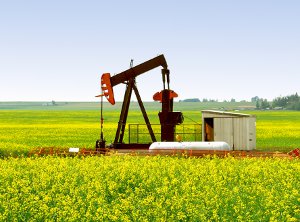
Oil Pumpjack in Alberta Canola Field
Alberta has the lion’s share of Canada’s oil industry. Its reserves – in the form of oil-sands – are estimated to be second only to Saudi Arabia’s. Calgary is one of Canada’s wealthiest cities.
Low taxes have brought many businesses to Calgary. Small businesses in Alberta pay just 2 percent tax, and there a 10% payroll tax.
Calgary is currently suffering the effects of the coronavirus pandemic and the global oil price crash.
The unemployment rate has risen from 7 percent in January 2020 to over 13 percent in May 2020, higher than the Canadian average of 11.5 percent. In the boom oil price years, 2013 and 2014, Calgary’s unemployment rate was below 5 percent.
The Calgary economy is expected to contract by 6 percent in 2020 with a prediction of 4 percent growth in 2021.
Approximately 110,000 jobs have been lost in Calgary in the last 12 months to May 2020. The largest job losses have been in accommodation and food services. There were job gains in utilities, educational services and health care & social assistance
Large construction projects underway include the Green Line LRT line, the 1,000 acre StoneGate Landing Business Park and the new Calgary Cancer Centre at the Foothills Medical Centre.

Downtown Calgary
The oil industry and its suppliers pay some of the highest salaries in Calgary.
The government, universities and schools aren’t quite as generous with their money but offer reasonable salaries and good conditions of employment.
Calgary is at the heart of the Canadian oil and gas industry which is struggling in 2020 and over 25,000 jobs have been lost in the last 12 months. This means that getting well-paid work will be difficult for many migrants when they first arrive in the city. Many of Calgary’s employers seem to look first for a local employee. If they can’t find a suitable local employee, employers will consider employing a migrant.
There is no general sales tax levied in Alberta, although shoppers need to pay a federal sales tax of 5 percent. Shoppers in other Canadian provinces have to add a combined sales tax to their purchases ranging from 11 percent in Saskatchewan to 15 percent in Nova Scotia and Prince Edward Island.
Alberta and Calgary’s public finances are very healthy, and the standard of healthcare compares favourably with other parts of Canada.
About Health
Although healthcare is good, you may find it difficult to get a family doctor when you first arrive in Calgary – there is a shortage.
Use this map here to find out the Primary Care Network (PCN) for your area. There are seven PCNs around and in Calgary. There is also this useful find a doctor page here.
If you haven’t registered with a family doctor, but need the services of one, you can use a walk-in clinic free of charge, provided you have an AHCIP card (Alberta Health Care Insurance Plan card).
When you arrive in Alberta you need to wait three months before you are eligible for an AHCIP card. This applies whether you are relocating internationally or from another Canadian province. To cover you during this time, private health insurance should be considered.
Environment and Getting Around

New Offices with +15 Bridge
Calgary has a very clean environment. It was rated as the world’s cleanest city by Forbes Magazine in 2007 (this is the most recent survey published) and as the world’s fifth most livable city by the Economist in 2019, down one place from 2018.
The 2019 “livability ranking” report measures 30 factors under five categories: stability, health care, education, infrastructure, and culture and the environment. Calgary received top marks for healthcare, education, infrastructure and stability.
Calgary has little litter, and the air is refreshingly clear and crisp. Mercer carried out a survey of quality of life in cities around the world and rated Calgary as the world’s top Eco-city on the basis of the city’s waste removal service, sewage systems, water drinkability & availability, and low air pollution.
Cats and dogs must be licensed by the City of Calgary.
Regulations prohibit pet cats from roaming in Calgary; this means that a cat must remain on the owner’s property.
Dogs must not be allowed off-leash unless they are in a securely fenced private yard or a designated off-leash area.
Calgary has 149 public off-leash areas, making a total of more than 1,250 hectares (3125 acres). Just over one-sixth of city parkland is designated off-leash.
Calgary has some wonderful, extensive parkland with unvandalised playgrounds. The parks have attractive paths and cycle routes – especially parks on the Bow River.
Buildings in downtown Calgary are linked by the +15 network of overhead pedestrian bridges, shown in one of the images on this page.
The +15 network is heated, so you can walk around the downtown’s buildings and shops in winter without the need for winter clothing.
The network (so called because the bridges are about 15 feet above the ground) is the biggest network of buildings connected by footbridges in the world, about 16 kilometers (10 miles) long in total.
Calgary’s public transport is reasonably good.

The Bow River, at Banff in the Rockies, west of Calgary
The C Train (a light railway) is reliable and runs from some of the suburbs into downtown Calgary. You can see the C Train’s Stations and routes here.
The C Train is powered by electricity generated by windfarms. Within downtown Calgary you can travel free on the C Train. Outside downtown, there are free park-and-ride-car-parks for the C Train and buses.
Park and Ride car parks feature free plug-in block heaters. These heaters are needed in cold weather to preheat car engines before they can start. The C Train stations aren’t enclosed, which makes for some very chilly waits in winter.
Most Calgarians prefer using their cars to public transport. City officials estimate that more than forty percent of downtown workers use the C Train regularly though.
Calgary’s growth has been faster at times than the government’s ability to cope.
Infrastructure is falling behind population and there can be traffic jams during rush hour.
People coming from larger cities in other countries will find the traffic relatively easy. Getting around is made harder by Calgary’s many traffic lights.
Suburban developments have outpaced school construction. This has led to lengthy journeys for some children and overcrowding of popular existing schools.
Where to Live in Calgary

New Houses – Calgary Suburban Sprawl

An Older Syle Home in Calgary
As Calgary boomed when oil prices were high, migrants flooded in from Europe, Asia and other Canadian cities.
Suburban development boomed too.
Calgary’s house prices are still affordable compared with Vancouver and Toronto.
The average price of a property in Calgary in April 2020 was $410,000 down one percent on the previous year. For a detached property the average price is around $500,000 and an average apartment / condominium will cost $250,000.
The number of house sales has dropped dramatically since the economic downturn and the current conditions make it a buyer’s market.
The city’s preferred residential areas lie in the North West and South West suburbs. These are closest to the Rockies with attractive mountain views.
The North East, where the airport is situated, and some rather industrial parts of the South East are often thought of as less favoured locations.
We’d recommend Tuscany, Edgemont, Country Hills, Dalhousie and Rosedale as good places to begin your search for a home.
We’d recommend West Hillhurst, Westgate and Springbank Hill as good places to begin your search for a home.
We’d recommend McKenzie Lake and Midnapore as good places to begin your search for a home.
Each of these areas has lower than average crime rates and offer residents an above average quality of life.
Summing Up
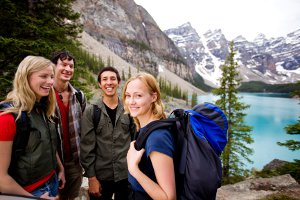
Into the Rockies
To some migrants, Calgary feels isolated – an island city in the middle of a vast prairie. Unlike Toronto, there are no other sizeable towns and cities nearby. It’s also a long way from the sea or sizeable lakes.
Most migrants, provided they can cope with the cool climate, find Calgary offers an extremely attractive lifestyle.
Calgary’s Negatives
The long, cold winter The rapid thaw and slush when the warm Chinook wind blows in winter The short summer A lack of history, historical buildings, and culture Rising violent crime rate High unemployment because of the economic downturnCalgary’s Positives
Low taxes Low house prices compared to Vancouver and Toronto Salaries above the Canadian average Clean and beautiful, with a modern, attractive downtown, a good-sized meandering river, and the rocky mountains backdrop The Rockies are easily accessible by car from Calgary Clean air A sunny climate – one of the sunniest in Canada – with low rainfall Chinook winds bringing mild days in winter Fantastic winter sports – with Canada Olympic Park Friendly people It’s easy to “get away from it all” into a huge province with a small population
Hi, my hubby n i would like to move there. It’s just 2 of us and we prefer to be nearer to nature but within 30mins drive to work for me. I am a nurse. We do lots of mtb and trail running and bird watching.
Any recommendations for areas to look at? Thanks!
Did you move yet? I am serching info on calgary, Alberta as well. My husband and two young daughters want to move to a safe environment. We live in To and as beautiful as this city is, it is becoming more and more violent w shootings etc as well as expensive. Not sure why but Alberta interests me so much!
I want to move from TO to Calgary with my husband and our son. Its difficult finding jobs on TO. And daycare. My husband does construction, is it a good idea to move to Calgary
Yes, Move to the NE because there are multiple daycares that you would be able to find. If you looked hard enough you most likely will find a job relating to construction. I suggest you move around the “Tara Springs” are because there is an amazing park and many little children your son could play with. the “Tara Springs” are is many little homes lined up together and I’m sure you will have a great time. There are also two daycares near the area. One in a community centre and one near a school located about a five-minute drive each. Happy travelling!
The NE of Calgary is newer and cleaner than some of the other areas. Houses are nice and more affordable. I can walk to several supermarkets and two major malls or take nearby public transport – what’s not to like? And some of the newer areas in the deep south are becoming crime hot-spots (McKenzie, New Brighton, Auburn Bay). Sick and tired of people (and the media) dissing the NE.
Other than that, good article on Calgary. Great place to live (and the winters aren’t that bad, and it cools off at night during the hot summers).
The NE is a good place but it’s not as good as you make it seem it is. Your saying these SE neighbourhoods are becoming crime hotspots but I have lived in New Brighton and it’s a great community. I’m not saying that the southeast is great as my friends house in Auburn Bay a few years back had a attempted break in but Calgary’s northeast community Cityscape has one of the highest amounts of break in’s.
I want to move from TO to Calgary with my husband and our son. Its difficult finding jobs on TO. And daycare. My husband does construction, is it a good idea to move to Calgary
this is a joke you list disireable places for the NW SW and SE but none for NE. I live in the NE and I think its better than any other part of the city cos atleast no one is nosey here and minds there own buisness and the neighbourhoods actually have a sense of community where everyone knows there neighbours
I am totally offended by the following statement:
“The North East, where the airport is situated, and some rather industrial parts of the South East are often thought of as less favoured locations.”
What is so wrong with the NE? Some very good friends live in Marlborough and it is a beautiful area, close proximity to the core and many amenities. I’ve heard the northeast described as undesirable and I’m sick of it. The NE is less expensive. has lots of shopping and is just as safe as anywhere else in this city. And, if you look on a map there are many, many communities that are not near the airport. I would rather reside in a well kept,mature area with lots of trees and a great community feel than in some of the newer,sanitized, everything is the same location.
I agree, I live in the NE and it is very nice here. There is so much shopping and beautiful areas to visit.
My husband and I are looking to move to Alberta for few years. We have a 10 months old baby. Any suggestions or advice where we should move to? I would like a safe place that I could live with my son and would like to take him to places that are baby friendly. I will really appreciate your recommendations.
My husband has been offered a wonderful carrer opportunity which means leaving Toronto and moving to Calgary. I don’t drive (yet) how hard will this make things.
We moved to Cal from TO 13 years ago without a car, assuming major cities are walkable like TO was. Not so much here. Be careful finding housing that you do have close access to grocery/ schools etc. Walking in winter to get groceries was not fun ( our neighborhood didn’t have a grocery store).
To the people relocating from Palm Springs.
Be advised that due to its elevation and proximity to the Canadian Rockies, Calgary can have unpredictable weather. Summers can be warm but they can also be cool. Actually, Calgary is the only major city to have recorded snow in all 12 months of the year. It snowed a bit in Calgary on July 15th 1999 much to everyone’s disappointment so if you’re looking to escape the heat, be careful what you ask for!
Calgary does get cold but dry and sunny with mild spells. The west coast of BC and Vancouver Island are damp. Very few warm days 20 or above until July. Alberta is the most comfortable weather in according to Environment Canada . Calgary has one of the milder winters of any large Canadian city Including Montreal and Ottawa. Toronto and Vancouver are warmer
Many communities on Vancouver Island have a mediterranean climate with much less rainfall then in Vancouver. Only the West side of Van Isle is “damp” however the majority of the population live on the drier side of the Island. The temperature will go above 20 C from May and September is usually also dry and warm.
Looking to move out of Palm Springs, CA. USA area in 2015 into Canada to get out of the regular fire areas and terrible heat during the summer months. Want to spend our golden years in Calgary, Alberta.
Um…… May want to spend your winters in Palm Springs and summers in Calgary, or better yet, the West Coast or Vancouver Island. Best of both.
I would say you stay in Palm Spring during the Winter…. There is no place nice in Canada during Winter that also includes Vancovuer & Victoria were its Damp, Wet and no sunshine for 95% of the time from October to April – June…..