
Average Daily Maximum Temperature – Minimum – Sunshine – Raindays – Snowdays – Snowdepth – Windspeed
Toronto has a semi-continental climate, with a warm, humid summer and a cold winter.

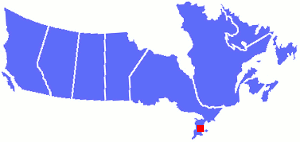
Toronto’s climate is modified by its location on the shores of Lake Ontario. The water in the lake ensures Toronto is warmer in winter and cooler in summer than it would otherwise be. The Great Lakes location is also the source of Toronto’s summer humidity, which many people find uncomfortable.
Although Toronto is one of Canada’s warmer cities in winter, winters are still severe, with snow on the ground most days between mid-December and mid-March. Snow deeper than 1 cm is seen on 65 days a year on average.
Ottawa, which is farther north than Toronto, and does not sit lakeside, has snow depths of greater than 1 cm on about 120 days each year.
Many factories and industrial plants in both Canada and the USA are located on the Great Lakes and smog has become something of a problem in Southern Ontario. About half of the smog is wind-borne from the USA.
Toronto’s smog is very much a summer phenomenon. Air quality can be classed as very good, good, moderate, poor or very poor. In 2012, Toronto had 59 days of moderate air quality and 2 days of poor air quality. The rest were good or very good. In 2014 Ontario closed its last coal-fired power plants, resulting in improved air quality.
Toronto enjoys a fairly sunny climate – its summers usually have an abundance of warm or hot sunny days, while its winters are rather less sunny than in the prairie cities of Calgary and Winnipeg.
Toronto’s day-to-day weather can be changeable throughout the year.
Toronto, Ontario
| Month of year  |
Av. Daily Max. Temp. (°C)  |
Av. Daily Min. Temp. (°C)  |
Av. hours Sun (per day)  |
Av. Days with Rain  |
Av. Days with Snowfall  |
Av. Depth Snow on Ground (cm)  |
Av. Wind Speed (km per hr)  |
|---|---|---|---|---|---|---|---|
| Jan. | -1 | -7 | 2.8 | 5 | 12 | 7 | 18 |
| Feb. | 0 | -6 | 3.9 | 5 | 9 | 7 | 17 |
| Mar. | 5 | -2 | 5.0 | 8 | 6 | 3 | 17 |
| Apr. | 11 | 4 | 6.2 | 11 | 2 | 0 | 17 |
| May | 18 | 10 | 7.4 | 12 | 0 | 0 | 14 |
| Jun. | 24 | 15 | 8.3 | 11 | 0 | 0 | 13 |
| Jul. | 26 | 18 | 8.9 | 10 | 0 | 0 | 12 |
| Aug. | 25 | 17 | 7.8 | 11 | 0 | 0 | 11 |
| Sep. | 21 | 13 | 6.3 | 11 | 0 | 0 | 12 |
| Oct. | 14 | 7 | 4.8 | 11 | 0 | 0 | 13 |
| Nov. | 7 | 2 | 2.8 | 11 | 3 | 0 | 16 |
| Dec. | 2 | -4 | 2.4 | 7 | 10 | 3 | 16 |
|
|
|||||||
The continental climate of Toronto is both moderated and hindered by the Great Lakes, most prominently, the influence of Lake Ontario where it has a long shoreline. The seasons vary greatly but not to the degree as further inland on the North American continent. Cloud cover increases greatly with the passage of the fall season so by late fall/early winter the sun rarely comes out. Very cold outbreaks can occur in Winter but most of the time, the temperature hovers near to, either above or below freezing, as a result precipitation varies in form from rain, to ice, snow, a mix and most dangerous of these forms but occurs less often – freezing rain. Springs are delayed due to the colder water bodies slowly warming out of the winter months, but there can be brief spikes of summer warmth.
Summer is warm and for long stretches humid, but rarely very hot or if so, only for short periods, nights are generally warm in the mid-summer, the bulk of precipitation results from thunderstorm activity. Early fall is most often a pleasant season, with plenty of sun, some rain with more refreshing nights.
Annual average mean temperature is close to 10C (9.7C Downtown U of T Campus) in built-up areas of the city removed from the immediate lakeshore, by comparison Montreal is 7C, Chicago, Boston & Vancouver average close to 11C, New York City 13C. In Europe, Dnipro, Ukraine has a comparable temperature profile, not as wet, or humid, with an earlier onset Spring but a sharper average temperature drop during the fall season.
“Although Toronto is one of Canada’s warmer cities in winter, winters are still severe, with snow on the ground most days between mid-December and mid-March. Snow deeper than 1 cm is seen on 65 days a year on average.”
This is completely incorrect. Snow is not on the ground most days in the City of Toronto from December to March. You are presenting a suburban perspective. Lake Ontario has a moderating effect.
Is there a specific name for how lake Ontario alters Toronto’s climate?
-Low-scale maritime moderation-. The lake slightly warms the city in fall and winter, and slightly cools it in spring and summer, and also dampens dirnual (day/night) temperature variation in the city compared to the countryside. Being located far into the North American landmass, it still a continental climate unlike Vancouver which is dominated by maritime influence from the Pacific Ocean.
it would be very helpful for me and for other people if you could please explain why Ottawa, Montreal and Toronto have the warmest summers every year and which states in canada have the coldest winters
It literally answers that in the first sentence… the Canadian Great Lakes.
New Brunswick, Quebec and the Prarie provinces have the coldest temperatures in Winter. Ottawa is the coldest major city in Ontario. Towns in Northern Ontario are also cold in Winter. The cities with most temperate climates in Both Winter and Summer are Vancouver and Victoria in British Columbia. Similar to Seattle in the U.S. it rains frequently.